November 4, 2026 · Martin Björck
The State of Skateboarding 2026: Money, Power and a New Generation
Vans has lost half its revenue, skate shops are closing, and Japanese teenagers win almost everything. Yet more Americans skate than a few years ago. A fact-based look at the skateboard industry, who runs the sport, how pros make a living, the big skate nations from the USA and Brazil to Japan and Australia, and what is happening in Europe.
Intro
Skateboarding in 2026 is two things at once. It is an Olympic sport with world rankings, national teams and medal targets. It is also a street culture built on small brands, skate shops, video parts and magazines. The two worlds overlap, but they are moving in different directions.
This article looks at the whole picture: how big the industry is, which companies matter, who governs the sport, how good skaters make money, why Asia wins so much, and what has happened to skateboarding in Europe. Everything is based on the sources listed at the bottom. Where the facts are uncertain or the sources disagree, we say so. In a few places I add information from people I know in the skate world, and I say so where it appears. There is a short note about me at the end of the article.
In short
- The market for skateboards is estimated at about US$3.6 billion a year, but the estimates come from commercial research firms and should be treated as rough.
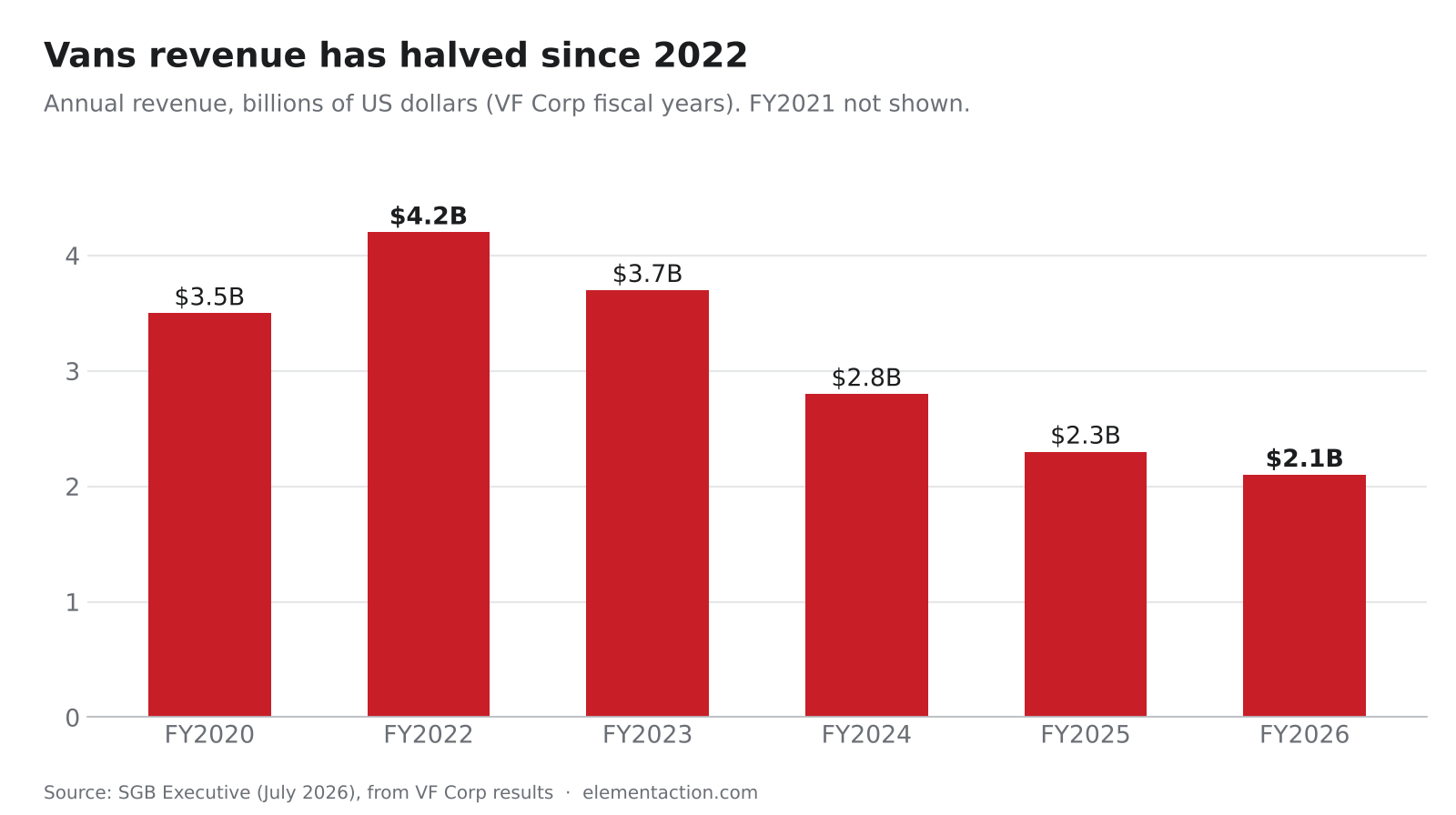
- Vans, the biggest skate brand, has seen its revenue fall from $4.2 billion to $2.1 billion in four years.
- Participation in the US has grown: about 9.9 million Americans skated in 2025. But fewer skaters enter contests, and many shops are struggling.
- Japan dominates Olympic and world contests. At the first LA28 qualifier in Rome in June 2026, Japanese skaters took 7 of 12 podium places.
- World Skate, a roller sports federation based in Switzerland, governs Olympic skateboarding. The culture itself is still shaped by brands, media and skaters.
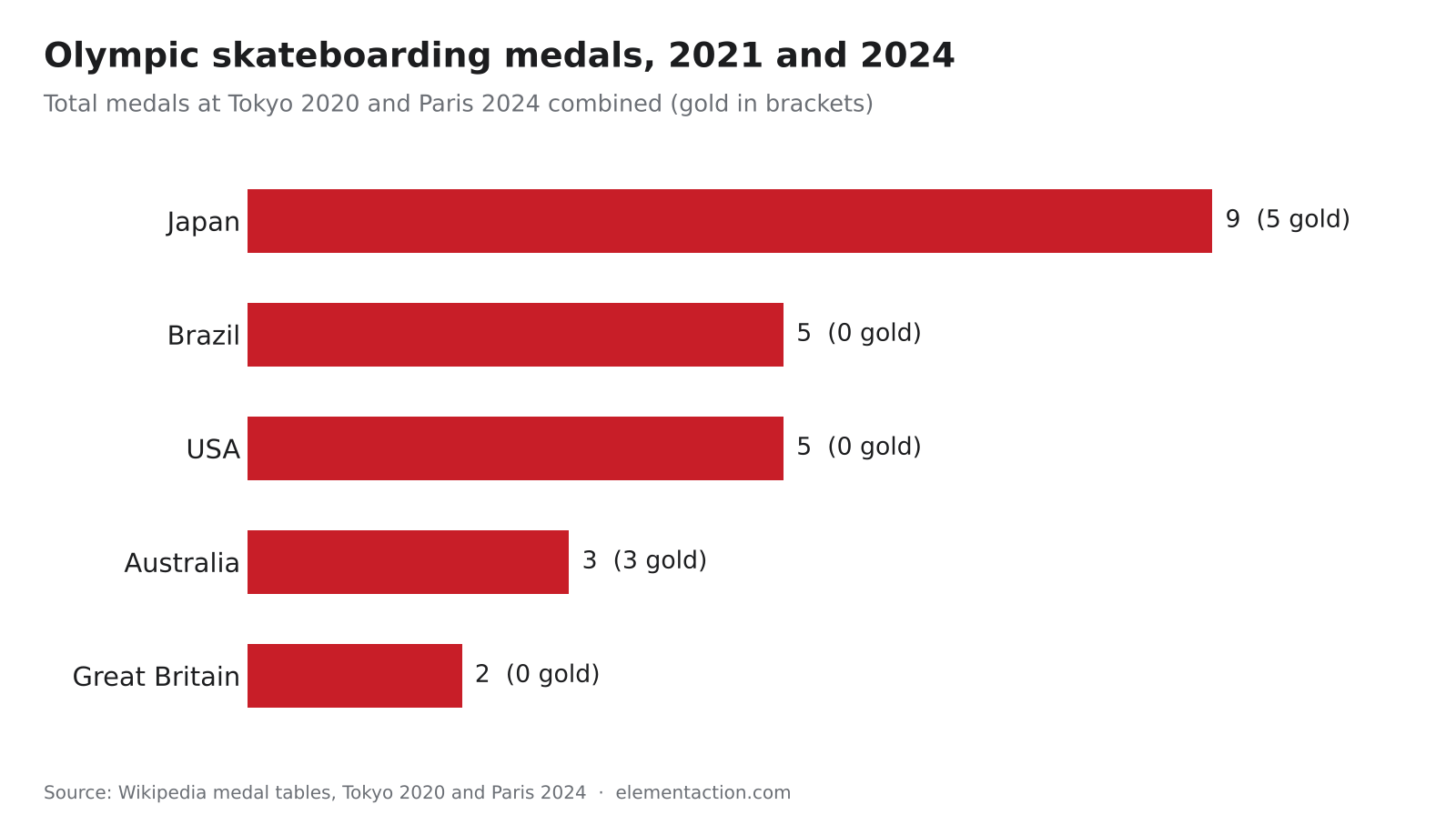
- The USA is still the centre of the industry and culture, Brazil is the second big skate nation, and Australia dominates Olympic park skating. But the USA has not won an Olympic skateboarding gold.
- A pro career is possible, but only a small group earns a good living from skateboarding alone.
How big is the skateboard industry?
Nobody publishes an official world figure for skateboarding. The numbers that exist come from market research firms that sell reports. Two of them, Fortune Business Insights and Expert Market Research, both put the global skateboard market at about $3.59 billion in 2025, growing at roughly 3.5 to 3.7% a year. According to Fortune Business Insights, North America is the biggest region, with about 38% of the market, and Asia-Pacific is growing fastest.
These figures mostly count boards and hardware. Skate shoes and clothing, which are much bigger businesses, are counted elsewhere. Treat them as an order of magnitude, not a precise measurement.
The more reliable numbers are about people. In the US, about 9.9 million people skateboarded in 2025, up from 9.3 million the year before, according to Statista's compilation of US participation data.
The biggest companies
Skateboarding has a few large companies and hundreds of small ones.
Shoes and apparel: the big money
- Vans (owned by VF Corporation since 2004, when VF paid $396 million) is the best-known skate brand in the world. After a long boom, its revenue fell from $4.2 billion in fiscal 2022 to $2.1 billion in fiscal 2026, according to SGB Executive. VF's turnaround plan has brought new management and layoffs. In May 2026 VF reported that Vans had returned to growth in its Americas direct-to-consumer sales for the first time in almost four years, but it still expects a decline for the brand in fiscal 2027.
- Nike SB and Adidas Skateboarding are skate divisions of the world's two largest sportswear companies. Their skate-specific revenues are not published.
- Supreme, founded as a New York skate shop, was bought by VF in 2020 for about $2.1 billion and sold to the eyewear group EssilorLuxottica in 2024 for $1.5 billion.
Hardware: decks, wheels and trucks
The hardware business is smaller and run largely by long-established American distributors. Fortune Business Insights names NHS (Santa Cruz, Independent, Creature), Skate One (Powell-Peralta, Bones), Globe International and Bravo Sports among the key players. Other important groups include Deluxe (Spitfire, Thunder, Real, Anti-Hero) and Crailtap (Girl, Chocolate).
Most decks are not pressed by the brand that sells them. They come from a handful of woodshops. According to a woodshop guide by the UK shop NOTE, BBS presses decks in Mexico for brands such as Baker, Anti-Hero and Polar. Control is in Quebec, Canada, HLC is in the Basque Country in Spain, and Dailan Huahong is in China. Production has largely moved to China and Mexico.
Retail
Zumiez, the biggest skate-oriented chain, has more than 700 stores in North America, Europe and Australia. Most skate hardware, though, is still sold through independent skate shops.
The threats
1. The post-pandemic hangover. Skateboarding boomed during the 2020 lockdowns. When demand fell back, the market was left with too much stock and heavy discounting, according to shop owners interviewed by Bubble Skateboard Magazine.
2. Private equity and broken companies. The American Prospect describes how investment firms bought and resold skate companies. Dwindle Distribution (Almost, Enjoi, Blind) was sold by Globe to a subsidiary of Transom Capital for $1.5 million in 2019 and had effectively collapsed by 2023. Liberated Brands, which ran Billabong, Quiksilver, Volcom and other surf and skate brands under licence from Authentic Brands, filed for bankruptcy in February 2025 with more than $220 million in debt. It closed all its stores, and more than 1,000 jobs were lost.
3. Tariffs. In 2025 the US introduced new tariffs on imports from China, Mexico and Canada, the three countries where most skate hardware is made. Shops and brands expected higher prices. According to Jenkem, average deck prices had already risen to around $75–85, and shops reported more "sticker shock" among customers.
4. Closing skate shops. Independent shops are under pressure from rent and costs. Bubble reports a shop in Bordeaux whose rent has quadrupled in 20 years. In Germany, Titus, the skate chain founded in 1978 by skateboarding pioneer Titus Dittmann, filed for insolvency in February 2025. Another company, 24/7 Distribution, took it over in July 2025 and closed six of its shops. In the UK, Bristol's Fifty Fifty closed in November 2025 after 28 years.
5. Too many brands, too few buyers. Several shops and writers point to a market with more brands than it can support, where each one sells too few boards.
6. Fewer kids competing. The contest platform The Boardr found that of 29,667 skaters who entered contests since 2017, 64% had not competed in the last three years, and participation fell after 2023.
Skateboarding is changing
The sport itself is changing in several ways.
- It is getting younger. At Tokyo 2020, Momiji Nishiya won street gold at 13, with 13-year-old Rayssa Leal second. In Paris, China's Zheng Haohao competed at 11. At the 2026 Park World Championship, both winners, Mizuho Hasegawa and Egoitz Bijueska, were 15.
- Park and contest skating have grown. Many young skaters, especially in Japan, learn in skateparks and through coaching and lessons. Skate schools are growing. One German school organiser told Bubble his programmes had grown about 20% in a year.
- More girls skate. Women's events are now equal parts of the Olympic programme. In the UK, the number of young women choosing skateboarding for the Duke of Edinburgh's Award rose from 39 in 2017 to 353 in 2022.
- The core scene feels older. Bubble argues that shop owners, brand managers and team riders are ageing, that teenagers have many other options, and that the core street scene and the Olympic scene now live in parallel.
So is skateboarding growing or shrinking? The honest answer is both. The number of people who skate in the US is rising, while contests, shops and the big brands are under pressure.
Professionals and amateurs: can you make a career?
Yes, there are professionals and amateurs, but in skateboarding the line is drawn by sponsors, not by a league.
The ladder
- Flow: free products from a brand, but no money.
- Amateur (am): on a team, with products and sometimes a small monthly payment. Surfer Today puts it at about $500–1,000 a month. Many ams have other jobs.
- Professional: a skater gets a pro model, a board or shoe with their name on it, and earns royalties from it.
How pros make money
- Board royalties: a share of every board sold with their name on it. According to Jenkem, some pros earn up to about $10 per board sold directly through the brand's website, where the margin is higher.
- Shoe deals: the biggest income for most top pros. According to Jenkem, a signature shoe with a large company can still pay a six-figure sum, but million-dollar deals from the start are no longer typical. A colourway, choosing the colours for an existing shoe, usually pays about $5,000.
- Energy drinks and lifestyle sponsors such as Monster and Red Bull.
- Contests: Street League Skateboarding (SLS), founded by Rob Dyrdek in 2010, has paid the biggest prize purses in skateboarding. In 2011 the total was $1.6 million, and the winner took $200,000. Some sponsors pay bonuses that match contest winnings.
- Olympic funding: national federations now fund their best athletes. Skateboard GB, for example, received about £1.67 million from UK Sport for the Paris cycle.
- Social media and video: YouTube, sponsored posts and the skater's own merchandise.
The reality. Most pros are independent contractors without health insurance, according to Jenkem. Careers are short, often 5–10 years, according to Surfer Today. Only a small group earns millions, such as Nyjah Huston, who by 2013 had already won more contest prize money than any other skater. For everyone else, skateboarding is often a mix of sponsorship, coaching, filming, working in the industry and other jobs.
Two routes to the top. Today there are two ways to "make it". The video route builds a name through video parts, magazines and brand teams. The contest route runs through national teams, world rankings and the Olympics. A few skaters, like Yuto Horigome, do both.
Who governs skateboarding?
Formally, Olympic skateboarding is run by World Skate. Its official address is in Lausanne, Switzerland, but the federation is run from Italy. An acquaintance of mine who visited the Lausanne address and knocked on the door found that it only receives post, which is forwarded to the staff in Italy. World Skate began in 1924 as the international federation for roller skating, and in 2017 it merged with the International Skateboarding Federation. It governs roller hockey, speed skating, scootering and many other wheeled sports as well. It has 130 member federations. Its president, the Italian Sabatino Aracu, has led the federation since 2005. He was confirmed for a new term at the congress in Rome in September 2024, and was re-elected at the World Skate Congress in Asunción, Paraguay, in October 2026, held during the World Skate Games.
World Skate organises the World Skateboarding Tour, the world championships and the Olympic qualification system. Under it are national federations, such as Skateboard GB in the UK and Sveriges Skateboardförbund in Sweden.
Who really decides? It depends what you mean.
- Olympic rules and qualification: the IOC and World Skate.
- Big contests: often private companies. SLS is owned by investors led by Lorenzo Fertitta's Fiume Capital, and ESPN sold majority control of the X Games to the investment firm MSP Sports Capital in 2022.
- What counts as good skateboarding, who is cool, which tricks matter: still the culture itself, meaning skaters, brands, filmers and media such as Thrasher.
The road to the Olympics was not smooth. When skateboarding was added for Tokyo in 2016, rival skateboarding federations fought over the right to run it, with lawsuits, before the IOC gave the job to the roller sports federation. Many skaters were also sceptical. In Sweden, the head of the national federation told SVT in 2016 that many were worried skateboarding's uniqueness would disappear if it became too much like other sports.
LA 2028. Skateboarding is on the programme again, with park and street for men and women, and 22 athletes per event. Qualification started in June 2026 and runs until June 2028, with a maximum of three skaters per country in each event.
Country by country: the big skateboard nations
Skateboarding has three kinds of power: industry (where the companies and money are), culture (where the videos, magazines and styles come from) and contests (who wins medals). Very few countries have all three.
| Nation | Industry | Culture | Contests | In one line |
|---|---|---|---|---|
| USA | ●●● | ●●● | ●● | Still the centre of the business and the culture, but no Olympic gold yet |
| Japan | ● | ●● | ●●● | The contest superpower |
| Brazil | ●● | ●●● | ●●● | Huge skate nation and home of the SLS final |
| Australia | ● | ●● | ●●● | Olympic park specialists |
| China | ●●● (manufacturing) | ● | ●● | Makes much of the hardware, and is building a team |
| Canada | ●● (wood) | ●● | ● | The maple behind the decks |
| Mexico | ●● (factories) | ●● | ● | Woodshops and a big street scene |
| South Korea, Chinese Taipei | ● | ● | ●● | New contest nations |
| Europe | ●● | ●●● | ●● | Strong culture, no Olympic gold |
The ratings are our own summary of the facts below, not an official ranking.
North America
USA. The US is still the heart of skateboarding. Most of the big brands, distributors, magazines and video productions are American, and about 9.9 million Americans skated in 2025. The big contests are there too: Street League, the X Games and Tampa Am. But in contests, the US has fallen behind: in Tokyo and Paris it won five of 24 Olympic medals and no gold, and no American woman has yet won an Olympic skateboarding medal. In a World Skate column, Niall Neeson writes that the USA relies on its "embarrassment of professional skateboarding riches", while Brazil and Japan have more organised national selection. At LA 2028, in California where the sport took off, the US will be skating at home.
Canada. Canada's biggest role is in the wood. Most decks are made from hard rock maple, which grows slowly in the cold winters around the Great Lakes, in Canada and the northern US. Woodshops such as Control in Quebec press decks for brands including Poetic Collective and Studio. In contests, Canada sent four skaters to Paris, including 14-year-old Fay De Fazio Ebert, who won women's park gold at the 2023 Pan American Games. She has said Canada lacks high-level training facilities.
Mexico. Mexico is a manufacturing country for skateboarding. The large woodshop BBS presses decks there for many well-known American brands, which is why the 2025 US tariffs on Mexico worried the industry. Mexico City has a big street scene. The government began building skateparks in the 1980s, and brands have followed: Nike SB built an Aztec-inspired park in the city in 2014, and Vans opened a House of Vans there in 2020. In contests, Mexico is still small. According to The Boardr, 88% of Mexican contest skaters had stopped competing, one of the highest rates.
South America
Brazil. Brazil is the second great skate nation of the Americas. A 2023 survey by Ibope Repucom estimated that 8.5 million Brazilians skate and more than 47 million follow the sport. Brazil has won five Olympic medals: Rayssa Leal (silver in Tokyo at 13, bronze in Paris), Kelvin Hoefler, Pedro Barros and Augusto Akio. The SLS Super Crown final is held in São Paulo, and at the first Pan American Games skateboarding contests in Santiago in 2023, Brazil won both street golds (Rayssa Leal and Lucas Rabelo).
The rest of South America. Peru's Angelo Caro finished fifth in Tokyo, took silver at the 2023 Pan American Games, and was second at the 2025 world street championship in São Paulo, held in March 2026. Colombia's Jhancarlos González won bronze at the Pan Am Games. In October 2026, Paraguay hosted the World Skate Games in Asunción. South America is producing more contest skaters every year, often from public skateparks rather than private training centres.
Asia
Japan is the strongest contest nation in the world (see the next section). At the 2026 Asian Games in Aichi-Nagoya, Japan won 7 of 12 skateboarding medals.
China makes a large share of the world's skate hardware and has built a national team from scratch since 2017. At the 2026 Asian Games, Zhu Yuanling won women's street gold and Cui Chenxi took bronze.
South Korea formed its national team only in January 2022, with six skaters all under 16, and the Korea Times reported then that no park in the country was equipped for professional training. Four years later, Kang Jun-i, 17, won Korea's first Asian Games skateboarding gold in men's street and took silver at the World Championship in Asunción.
Chinese Taipei won two park silvers at the 2026 Asian Games.
India is at an early stage. It has new skateparks such as Janwaar Castle, a rural park where children skate for free on the condition that they go to school, and a 44,000-square-foot park in Chandigarh opened in 2023. No Indian skater has yet qualified for the Olympics.
Oceania
Australia is the world's best park nation at the Olympics. Keegan Palmer won park gold in both Tokyo and Paris, and Arisa Trew won women's park gold in Paris at 14, becoming Australia's youngest Olympic gold medallist. Street skater Chloe Covell won the first LA28 qualifier in Rome in June 2026.
Europe
Europe has a strong culture and many world-class skaters, but it does not have Japan's depth. Highlights:
- France: Aurélien Giraud was street world champion in 2023, and Paris hosted the Olympic skateboarding at Place de la Concorde in 2024.
- Great Britain: Sky Brown has won Olympic bronze in both Tokyo and Paris.
- Spain: Egoitz Bijueska became park world champion in 2026 at 15. The Basque Country is also home to the woodshop HLC.
- Portugal: Gustavo Ribeiro won the SLS Super Crown in 2022, the first Portuguese skater to do so.
- Sweden: Malmö is a model skateboarding city (see the Europe section below).
Africa
South Africa is Africa's leading contest nation in skateboarding and sent skaters to both Tokyo and Paris. Boipelo Awuah, from Kimberley, qualified for women's street in Paris after a pelvic fracture kept her out of Tokyo. Local skaters report more girls at skateparks, but also limited resources and poorly organised women's contests. The charity Skateistan, founded in Kabul in 2007, runs skate schools in South Africa, Cambodia and Afghanistan for more than 6,000 children a week, 54% of them girls. A film about its Kabul school won an Oscar.
Why does Asia dominate?
Above all, it is Japan that wins, with China, South Korea and Chinese Taipei catching up. In the street world final in Asunción, South Korea's Kang Juni took silver. In Rome in June 2026, China's Cui Chenxi took bronze in women's street. These are the explanations given in the sources:
- Perfect timing. Japan's national coach, Daisuke Hayakawa, has said that the growth of Japanese skateboarding and the Olympics "crossed paths at just the right time". He told Olympics.com that from around 2010, social media and YouTube let Japanese kids see world-class skating and aim to be number one in the world, not just in Japan.
- A contest pathway. Japanese skaters were sent to international contests early. In 2018, the big American amateur contest Tampa Am held a qualifier in Japan, which Sora Shirai won. He went on to become world number one.
- Skateparks and coaching. Street skating is less common in Japan, so most kids learn in skateparks, with instructors, from a young age. World Skate's Niall Neeson told Olympics.com that this means they learn the basics earlier.
- Parents and status. Skateboarding used to be seen as a pastime for troublemakers in Japan. After Tokyo, it became a sport kids take lessons in, with parents driving them to the park and buying new boards. Hayakawa told the South China Morning Post that the number of skaters had tripled since Tokyo.
- They keep going. According to The Boardr's data, only 27% of Japanese contest skaters had stopped competing, against 69% in the US and 84% in Australia.
- State programmes in China. After the Olympic decision, China opened six regional training camps in 2017 and recruited athletes from gymnastics, martial arts and other sports through its sports school system, according to Sixth Tone. Skateboarding is now part of China's National Games.
The numbers show the result. At the first LA28 qualifying event in Rome in June 2026, Japanese skaters took 7 of the 12 podium places. According to a World Skate column in 2025, Japanese skaters held the top four places in the men's street world ranking and seven of the top ten in women's street.
What has happened to skateboarding in Europe?
Europe has a strong skate culture, but its industry and its elite results have both been under pressure.
The good news: skateparks and grassroots
- Malmö in Sweden has become a model for how a city can support skateboarding. It has a municipal skateboard coordinator, the Bryggeriet skatepark (opened in 1998 in an old brewery), and Bryggeriets Gymnasium, a high school built around skateboarding.
- In Sweden, skateboarding became a member of the national sports confederation (RF) in 2013. At the time, the Swedish federation, Sveriges Skateboardförbund, had about 12,000 members and estimated there were about 100,000 skaters in Sweden.
- Olympic status has brought money. Skateboard GB got about £1.67 million from UK Sport for Paris 2024, up from £166,825 in 2018.
- Skate schools and girls' skateboarding are growing in several countries.
The bad news: shops, events and brands
- Germany's biggest skate retailer, Titus, went insolvent in 2025 and closed six shops. The UK's Fifty Fifty closed after 28 years.
- Shops in France and elsewhere report rents and costs rising faster than sales. A Spitfire wheel costs about €70 in Europe, compared with about $55 in the US, according to Bubble.
- CPH Open, the famous Copenhagen festival when skaters took over the city's streets, ended in its original form in 2018 because the crowds had become a safety risk. The festival has been held again since, for example in 2023.
Elite results. European skaters win medals: Sky Brown won bronze for Great Britain in both Tokyo and Paris, and Spain's 15-year-old Egoitz Bijueska became park world champion in 2026. But Europe does not have Japan's depth. No European country won an Olympic skateboarding gold in Tokyo or Paris.
The future
Based on the trends above, these are the most likely directions. They are our assessment, not facts:
- More Olympic structure. LA 2028 will put skateboarding in front of a huge American audience, and federations will keep building national teams and coaching programmes.
- Asia will keep winning for years. Japan's skaters are young and do not quit, and China is investing through its state system.
- The industry will consolidate. Weak brands will close or merge, prices will stay high, and shops will lean more on lessons, events and their own shop decks.
- The big brands must win back skaters. Vans' recovery is the key question. VF itself expects the decline to continue into 2027.
- Two cultures, one board. The Olympic sport and the street culture will keep existing side by side. For most skaters, skateboarding will stay what it has always been: something you do with your friends, not for medals.
About the author
I'm Martin Björck, the founder and editor of Elementaction and of the event calendar skateboardeventcalendar.com.
This article was researched and written with the help of AI tools, and every fact was checked against the sources below. A few details come from people I know instead, such as an acquaintance's visit to World Skate's address in Lausanne, and I say so where they appear. If you spot an error, please tell me through the contact link on the About page, and I will correct it.
Sources
- Fortune Business Insights: Skateboard market
- Expert Market Research: Skateboard market
- Statista: Skateboarding participants in the US
- SGB Executive: The post-Covid rocky history of Vans (July 2026)
- The Motley Fool: VF Q4 2026 earnings call transcript (May 2026)
- Retail Dive: VF sells Supreme to EssilorLuxottica (2024)
- The American Prospect: Private equity ripped the heart out of skateboarding (2025)
- NOTE: Woodshop guide and directory
- Shredder News: Tariffs set to raise skateboard prices (2025)
- Jenkem: In this economy, are more skaters buying shop decks? (2025)
- Jenkem: 16 things you didn't know about professional skateboarding
- Surfer Today: How pro skateboarders earn money
- Surfer Today: The closure of yet another skate shop (2026)
- BUBBLE Skateboard Magazine: Why skateboarding got old
- The Boardr: Is skateboarding growing or shrinking? (2025)
- FashionUnited: Titus is insolvent (2025)
- FashionUnited: 24/7 Distribution takes over Titus (2025)
- Wikipedia: World Skate
- World Skate: Aracu confirmed as president (2024)
- Sports Destination Management: Skateboarding world in disarray (2016)
- Wikipedia: Street League Skateboarding
- Fortune: ESPN sells X Games to MSP Sports Capital (2022)
- Surfer Today: LA 2028 skateboarding qualification explained
- Forbes: LA28 standings after first Olympic qualifier (June 2026)
- Wikipedia: Skateboarding at the 2020 Summer Olympics
- Wikipedia: Skateboarding at the 2024 Summer Olympics
- Olympics.com: 13-year-old Nishiya Momiji wins gold
- Olympics.com: How Japan came to dominate skateboarding
- South China Morning Post: How Japan's skateboarding youth turned the tide (2024)
- World Skate: Currents, the Japanese armada
- Sixth Tone: Team China aims to conquer skateboarding (2021)
- Wikipedia: Zheng Haohao
- Newsgd: Skateboarding at China's 15th National Games (2025)
- Duke of Edinburgh's Award: 800% rise in young women skateboarding (2022)
- Wikipedia: Skateboard GB
- Riksidrottsförbundet: Skateboard new RF sport (2013)
- SVT: Skaters sceptical about the Olympics (2016)
- Huck: Is Malmö the most skateboarding-friendly city in the world? (2016)
- Boardworld: CPH Open, the final chapter (2018)
- DOSE: This was CPH Open 2023
- SGI News: New Boardriders licensees after Liberated bankruptcy (2025)
- World Skate: Currents, Team USA's date with destiny at LA28
- World Skate: Asian Games 2026 park and street results
- Korea Times: South Korea wins gold in men's street at the Asian Games (2026)
- Korea Times: Korea's skateboarding scene needs more (2022)
- World Skate: Pan American Games 2023 results
- Máquina do Esporte: Ibope Repucom survey on skateboarding in Brazil (2023)
- Canadian Olympic Committee: Team Canada skateboarders for Paris 2024
- Ripped Laces: What skateboard decks are made of
- Latin Post: Mexico City's skateboarding scene grows (2022)
- Wikipedia: Ángelo Caro
- Ben Waterworth: Australia's most successful Olympic skate campaign (2024)
- Wikipedia: Aurélien Giraud
- Olympics.com: Gustavo Ribeiro
- Wikipedia: Skateboarding in India
- ESPN Africa: Boipelo Awuah (2024)
- TimesLIVE: South African female skateboarders carving out space (2026)
- Wikipedia: Skateistan
- Our own reports: Park World Championship, Asunción 2026 and Street World Championship, Asunción 2026
Read next
 November 7, 2026Snowboard Resort Guide: 26 Resorts for Park, Powder, Pistes and PartiesFrom the Laax superpipe and the glaciers of Saas-Fee to the deep snow of Niseko: 26 resorts that snowboarders keep returning to, with updated 2026/27 figures for altitude, pistes, lifts, parks and season dates.
 October 31, 2026Where the Snow Is: A Rider's Guide to the World's Slopes, 2026/27North America, Canada, Japan and Europe: when the big resorts open this winter, what each region is known for, how to read a snow report, and where to check live snow and avalanche conditions before you go.
 October 30, 2026From Snurfer to Olympic Gold: The History of the SnowboardA Minnesota sled in 1917, a toy built in a Michigan garage on Christmas Day 1965, a handful of stubborn board builders and a fight to get onto the lifts. How snowboarding went from banned to Olympic in about thirty years.