November 3, 2026
Portugal in 1992: What the Stormrider Guide Saw
In 1992 the first Stormrider Guide Europe called Nazaré 'Portugal's most underrated wave' and Ericeira 'the Mecca of Portuguese surfing'. We read the Portugal chapter again, spot by spot, and checked what happened next.
Intro
In 1992 the British surf shop and publisher Low Pressure released the first Stormrider Guide Europe, often described as surfing's answer to the Lonely Planet guides. Ollie Fitzjones did most of the work, with Bruce Sutherland helping with research and writing, and Dan Haylock with photography. For a generation of travelling surfers, its hand-drawn maps and numbered spot lists were how you found waves in Europe.
The Portugal chapter runs from page 156 to page 171. It numbers 72 breaks, from Moledo on the Spanish border to Santa Maria in the Azores, and much of it was written by Portuguese surfers themselves: João Valente of Surf Portugal magazine, Nick Uricchio of Semente Surfboards in Ericeira, and Eduardo and Álvaro of Polen Surf Designs.
We read it again, more than thirty years later. This article describes what the guide saw, re-draws its spot numbering on modern maps, and checks what has changed since. The book is copyrighted, so we summarise it in our own words with only short quotes. If you want the spots as they are today, read our region-by-region guide to surfing Portugal.
Portugal at a glance, 1992
The chapter opens with a fact box, and a few lines show how long ago 1992 was:
- Currency: the escudo. Portugal replaced it with the euro in 1999, and euro notes and coins arrived in 2002.
- Population: 10.47 million. The figure has barely changed since.
- Weather info came from the newspaper Diário de Notícias and the TV weather on Channel 1 at 8.15 pm, which sometimes gave the swell size around the Azores. The guide adds a joke: watch out for Roger Ramjet re-runs after the weather.
- Surf reports came from "Disc Surf", a 24-hour phone line in Portuguese covering Costa da Caparica to Peniche, with a line for the north being prepared.
Today, of course, you check a forecast on your phone. (See our guide to surf forecast sites and buoys.)
The guide also gets the conditions right in a way that still holds: the water is cool all year, so you need a full wetsuit for autumn, winter and spring, and a spring suit for summer. Booties are a good idea because of sharp reefs and sea urchins. Most swell comes from North Atlantic lows, though W and S swells are also common.
The scene: "a very decisive point"
João Valente's text on Portuguese surfing describes a sport at a turning point. In his words, it was "trying to pull itself together after years of total chaos."
According to the guide:
- Surfing only began to organise itself in the mid-1980s, when it also became good business. Almost every major international surf company was established in Portugal, and a small local industry grew up alongside.
- The Portuguese Surfing Federation (FPS) had been founded but struggled, being too dependent on government money. By 1992 it was run by members of the Viana Surf Club from the north, and a private sponsor was funding a national circuit of six contests. If it went as planned, Portugal would get its first national champion that year.
- The surfing community probably numbered about 30,000, most of them young, between 15 and 18.
- Two companies led the surfboard industry: Polen, one of Europe's biggest factories, and Semente, which Valente called one of the most hardcore.
- There were two surf magazines, Surf Portugal and Surf Magazine, a bodyboard magazine and a newspaper, Notícias do Mar.
The guide names the surfers to know: Dapin, Jorge Leote, João Antunes, Bruno Charneca, Rodrigo Herédia and Nuno Mata among the established names, and Marcos Anastácio, Felipe Gatinho and Hugo Zagalo among the young upstarts. In the 1970s, the best was Paulo Inocentes from Carcavelos. There was also a big-wave crew at Ericeira who almost never competed but never missed a big day, including Tó Gama, who was also a forcado, one of the men who grab the bull by hand in Portuguese bullfighting.
What we could verify: the FPS's own 25th-anniversary coverage gives its founding date as 14 March 1989, not 1988 as the guide says. Polen and Semente are both still making surfboards. Ericeira is still the home of Semente, which Nick Uricchio co-founded.
What the guide didn't know about the history
The guide's history of Portuguese surfing is short, and later research has added a lot:
- Pedro Martins de Lima (1930–2023), now called the father of Portuguese surfing, bodysurfed at Carcavelos from 1946, rode a cork bellyboard from 1947, and bought a 16 kg surfboard in Bayonne in 1959. He then surfed Carcavelos, Praia Grande, Ericeira and Ribeira d'Ilhas, often alone, for about nine years. He died in 2023 at the age of 92.
- In the national film archive, researchers found a short black-and-white film from the 1920s showing a dozen people riding waves on bellyboards at Leça da Palmeira, near Porto. Surfer Today presents it as possibly the oldest surf film in Europe.
- The guide claims that photos of huge surf at Guincho, published in Surfer in September 1967, first made the world aware of Portugal's potential. We could not verify this, so treat it as the guide's own claim.
Water quality: the guide's warning
The most striking part of the chapter is how openly it discusses pollution. João Valente wrote that the surfing community was "not yet environmentally active" and that many beaches were heavily polluted, mostly by sewage.
- The Estoril line, from Cascais to Lisbon, had serious sewage problems, and Carcavelos was the most affected, with many cases of eye and skin irritation.
- Matosinhos, in Porto, had the biggest problem of all, with human sewage mixing with blood from a slaughterhouse.
- South of Leirosa, near Figueira da Foz, beach walkers reported foam and a stink from two paper mills.
- At Ericeira, Nick Uricchio feared that sewage outlets built for a small fishing town could not cope with the growth.
- The guide's only positive note was the surf schools, which were teaching children to collect rubbish on the beach. Surf Portugal planned a donation to the Surfrider Foundation.
Today: bathing water in Portugal is monitored every season and the results are published, but problems have not disappeared. In 2017, for example, Carcavelos was closed to bathing after heavy rain, when a stream overflowed onto the beach. The pulp company Celbi at Leirosa now sponsors volunteer beach clean-ups there. And Ericeira's surfers did organise: local groups including Salvem o Surf ("Save the Surf") and the Friends of Coxos Bay helped make it a World Surfing Reserve.
The 72 breaks, re-drawn
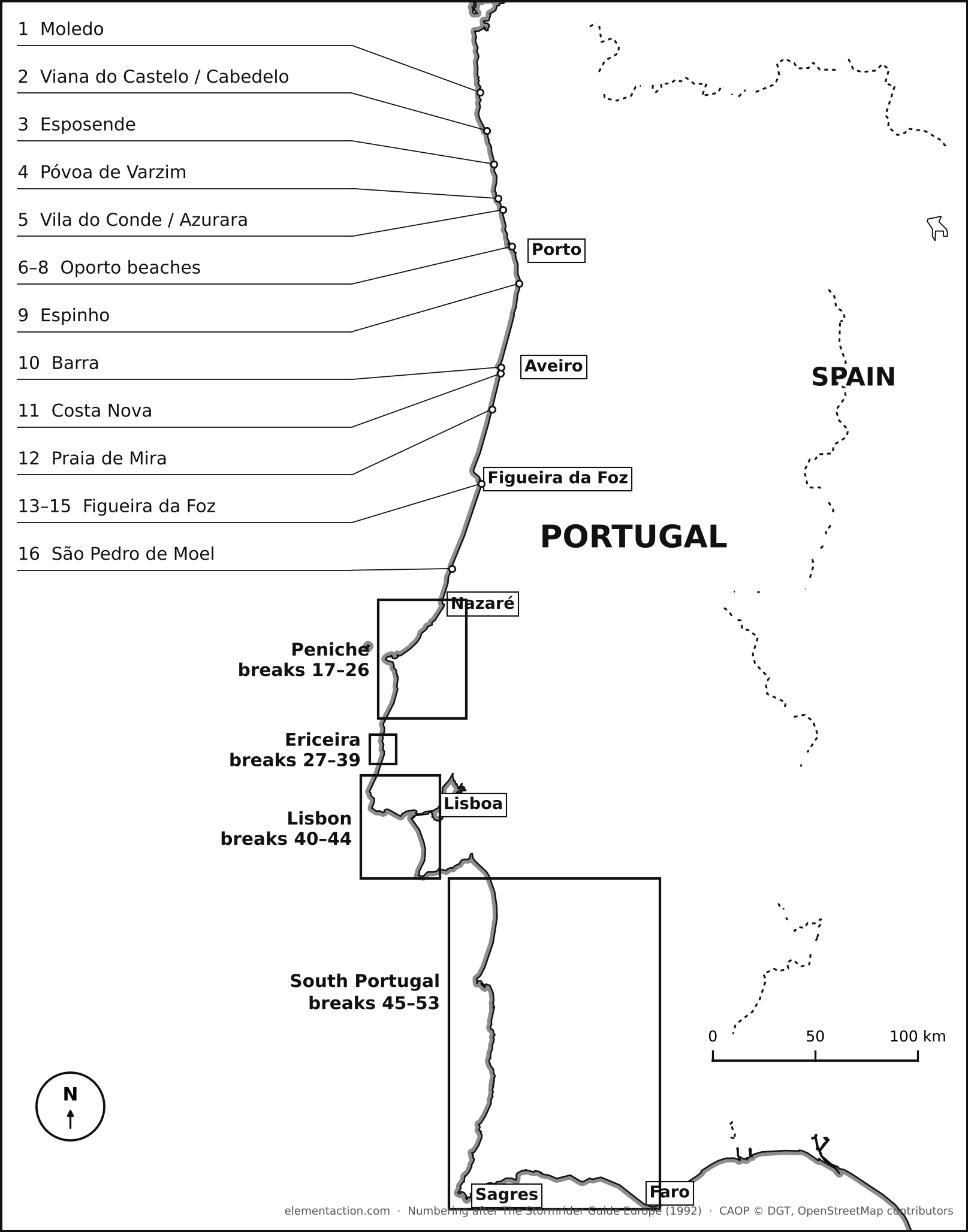
The guide divides mainland Portugal into five parts: breaks 1–16 along the north and centre, then four detailed areas: Peniche (17–26), Ericeira (27–39), Lisbon (40–44) and South Portugal (45–53). We re-drew its numbering on a modern map. The positions are ours, based on the guide's descriptions, and are approximate.
A few details stand out when you read the spot list today:
- 10. Barra (Aveiro): "Now only works on big swells," the guide says, because beach development had killed it. (Note that the guide's own map labels number 10 "Barra do Douro", the Porto river mouth, while the text puts it at Aveiro. We follow the text.)
- 13–15. Figueira da Foz: the guide praises Cabedelo's long, grinding rights beside the Mondego pier. In 2009 surfers formed SOS Cabedelo to protect the wave after an extension of the jetty seemed to change it.
- 6–8. Oporto: good waves, but the guide warns that the River Douro emptied sewage and industrial waste into the sea "at an alarming rate."
Peniche: "one of the most publicised waves in Europe"
The guide calls Peniche "one of the most versatile surf venues in Europe", thanks to its many breaks facing different ways within a 20-mile radius. It already knew Supertubos (23) as a heavy, hollow beach break that snapped boards, with a nearby fish factory adding its own smell to the experience.
Its most famous line is about Nazaré (17). Quoting the American magazine The Surf Report, it calls it "Portugal's big wave spot", 6–22 ft over sand, and João Valente calls it "probably Portugal's most underrated wave".
What happened next:
- Nazaré became the home of the biggest waves ever ridden. Garrett McNamara's ride in 2011 started it, and Sebastian Steudtner's 26.21 m wave in 2020 is the current record. Read the full story in Nazaré and Mavericks.
- Supertubos hosted its first WSL Championship Tour event in 2009, when Mick Fanning won, and it has been a regular stop since. John John Florence won his first world title there in 2016.
Ericeira: "the Mecca of Portuguese surfing"
Nick Uricchio's text opens with the line that Ericeira "was and is the Mecca of Portuguese surfing". In the early days, he wrote, Ericeira was a small fishing village with cheap rooms, rugged beaches and no crowds. By 1992 apartment blocks and hotels were going up, and he worried about rubbish and sewage. He mapped 13 breaks, from São Lourenço (27) to São Julião (39), in a stretch of about 11 km by water. He called Coxos (28) "said to be the best righthander in Europe", and described Pedra Branca (34) as a deadly left over a rock platform, "suicide at low" tide.
What happened next: On 14 October 2011, Ericeira became Europe's first World Surfing Reserve, protecting seven of the breaks the guide listed: São Lourenço, Coxos, Crazy Left, Ribeira d'Ilhas, the Reef, Pedra Branca and Cave. Today the town is one of the busiest surf destinations in Europe, which is just what the guide predicted.
Lisbon and the South
For Lisbon, the guide gives credit to the Estoril–Carcavelos coast as the place where wave sports in Portugal were born. It praises Praia Grande (40) as the most consistent spot, and notes that Guincho (41) was Portugal's most popular wave-sailing spot and hosted the Guincho Wave Classic windsurf event. Its advice on water quality: Guincho and Costa da Caparica (44) were cleaner alternatives to the city beaches, so "vote with your feet."
For the South, the guide calls the coast "one of Europe's surfing enigmas", with many good peaks discovered and many more rumoured. Its tips still apply: late winter is often the best time, the west coast is the most consistent, and Faro was the cheapest place to fly to. Spots included Arrifana (51), with a hazardous right-hand reef on the edge of the bay, and Tonel at Sagres (52), where tubular waves break over rocks in a compact beach. The guide notes that early Portuguese navigators thought of Sagres as "Lands End".
The Azores, breaks 54–72
The chapter ends with the Azores, nine volcanic islands in the mid-Atlantic, with good surf but very little contact with the outside world. According to the guide, surfing reportedly began there as bodyboarding around the turn of the century. Home-made surfboards were first ridden in 1962 or 1963, but there was little contact with foreign surfers until the mid-1970s, when US Air Force personnel stationed on Terceira started surfing. The guide warns that locals could be unfriendly, especially on the north coast of São Miguel.
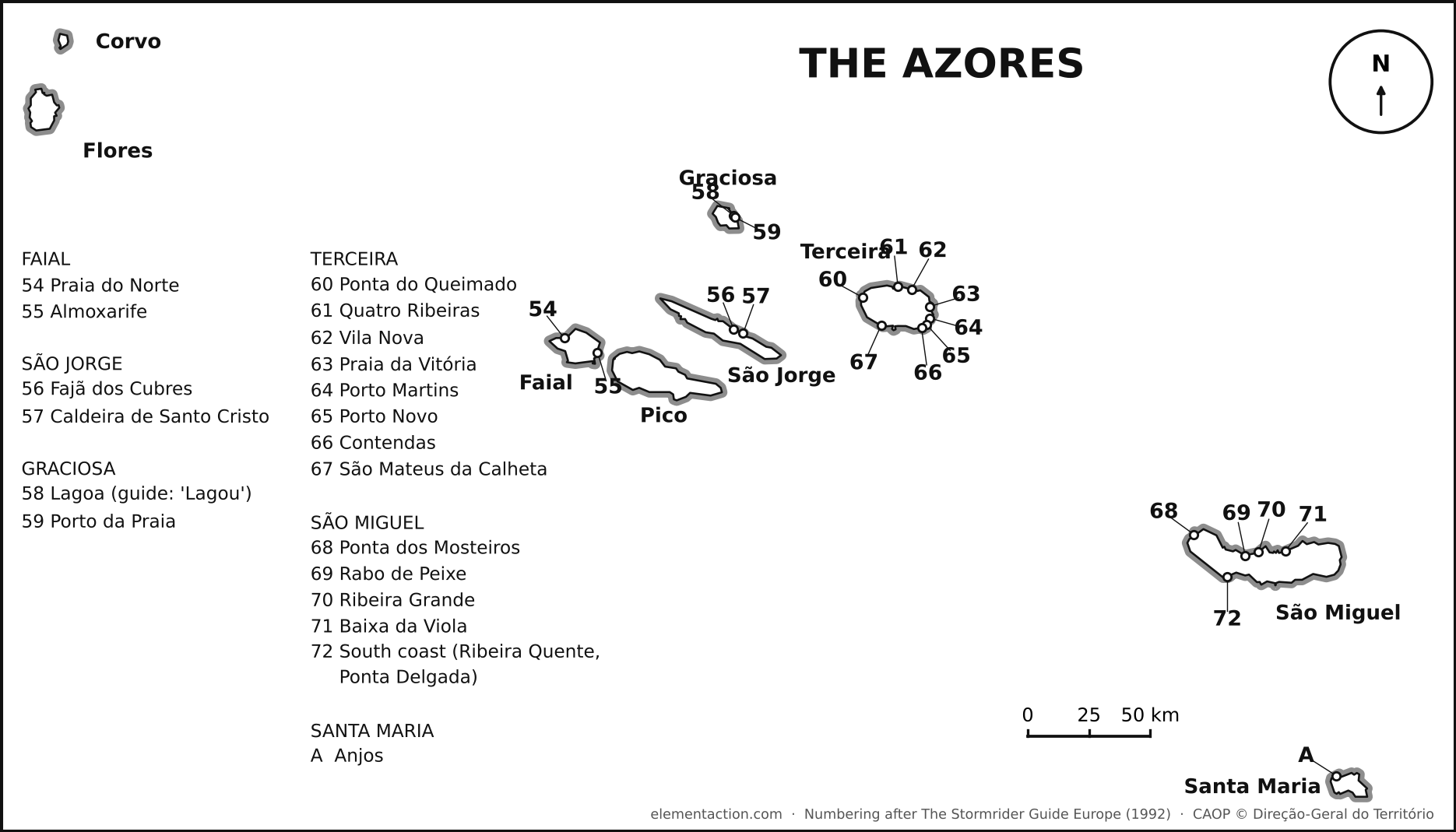
On São Jorge, the guide mentions two breaks at Fajã dos Cubres, the first "reputedly Portugal's longest left", and a long left at Fajã da Caldeira, rarely surfed. Today the Fajã da Caldeira de Santo Cristo, reached only by foot or quad bike, is famous among surfers for its lefts.
What happened next: São Miguel became the main surf island. Praia de Santa Bárbara at Ribeira Grande, near the guide's breaks 69–70, has hosted international WSL contests, including a Qualifying Series event in September 2019.
Reading an old surf guide today
An old guide is still useful, as long as you know its limits:
- Sandbanks move. Beach breaks described in 1992 may work very differently today, and some, such as Barra, were already being changed by building.
- Phone numbers, prices and addresses are history. Escudos, fax numbers and the Disc Surf phone line are now curiosities.
- Reefs and points last. Coxos, Ribeira d'Ilhas, Supertubos and Nazaré are where the guide put them, and many of its warnings about shallow reefs and currents still apply.
- The people matter. The guide was written with Portuguese surfers, shapers and journalists. Many of the names it mentions went on to shape Portuguese surfing.
Sources
- The Stormrider Guide Europe, first edition (Low Pressure, 1992), Portugal chapter, pp. 156–171
- Encyclopedia of Surfing: Stormrider Guides
- Biblio: The Stormrider Guide Europe (Fitzjones, Rainger, Sutherland, Haylock)
- Surftotal: Federação Portuguesa de Surf celebrates 25 years (2014)
- Surfer Today: Pedro Martins de Lima, the father of Portuguese surfing
- The Portugal News: Father of Portuguese surfing passes away at 92 (2023)
- Surfer Today: Leça da Palmeira, the roots of European surfing
- Time Out Lisboa: Carcavelos closed to bathing (2017)
- Altri: Celbi sponsors the voluntary clean-up of Leirosa Beach
- Surfer Today: Ericeira is a World Surfing Reserve
- Wikipedia: World Surfing Reserves
- Diário de Notícias: SOS Cabedelo, the fight for a wave (2017)
- Red Bull: Spot check, Supertubos, Peniche
- World Surf League: QS chase continues in Azores (2019)
- Azores Getaways: Surfing in the Azores
- Maps: coastline from CAOP, © Direção-Geral do Território; Spain from OpenStreetMap contributors (ODbL). Spot numbering after the Stormrider Guide Europe (1992).
Read next
 November 3, 2026Surfing Portugal: A Region-by-Region Map of the SpotsFrom the river mouths of the Minho to the reefs of Ericeira and the cliffs of the Costa Vicentina: Portugal's surf coast in six regions and seven maps, with what each spot needs to work.
 October 30, 2026Nazaré and Mavericks: Inside the World of Big-Wave SurfingA canyon that turns Atlantic swell into the biggest waves ever ridden, and a cold, shark-patrolled reef off California that one teenager surfed alone for years. The history, physics, records and risks of big-wave surfing at Nazaré and Mavericks.
 October 13, 2026Surf Forecasts Like a Pro: Buoys, Best Sites and Where to Check the WavesHow forecasters read ocean buoys, which surf forecast sites are free and which are worth paying for, which tools suit which coast, plus webcam and surf spot sites. With prices, sources and a list of what we could not verify.