November 3, 2026
Surfing Portugal: A Region-by-Region Map of the Spots
From the river mouths of the Minho to the reefs of Ericeira and the cliffs of the Costa Vicentina: Portugal's surf coast in six regions and seven maps, with what each spot needs to work.
Intro
Mainland Portugal has more than 800 km of Atlantic coastline facing straight into the North Atlantic storm track, and it gets surf all year. There are long beach breaks, river-mouth sandbars, some of the best reefs and points in Europe, and the biggest waves ever ridden. Just as useful: because the coast bends, there is almost always a spot sheltered from the wind somewhere within an hour's drive.
This guide splits the mainland into six regions, from north to south. Each has its own map in the style of the classic printed surf guides, with numbered spots. For the history of surfing in Portugal, and how the coast looked to travelling surfers in the early 1990s, read our companion piece on Portugal in the 1992 Stormrider Guide, which also covers the Azores.
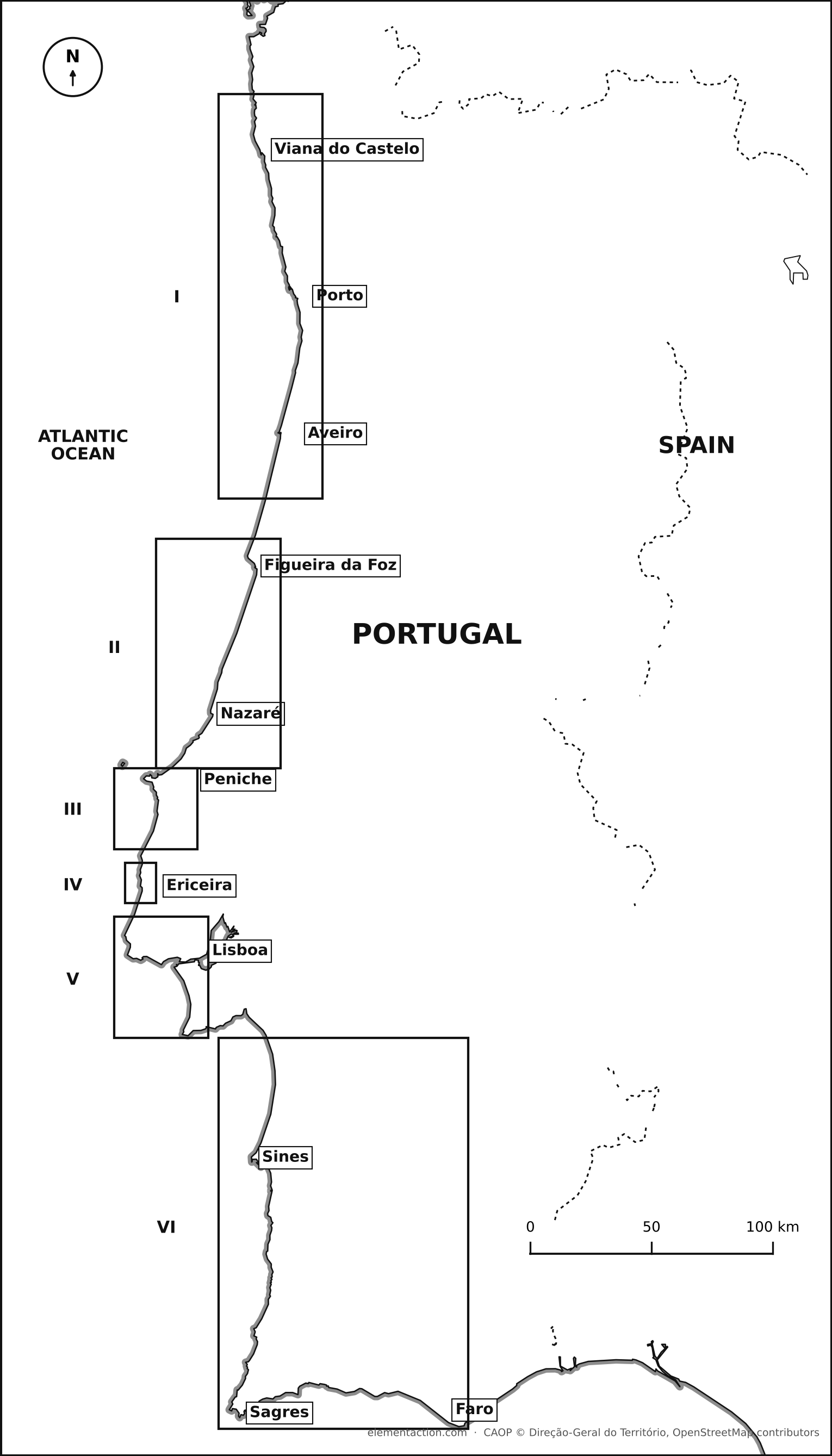
A note on accuracy. Spot positions on the maps are approximate, and descriptions summarise the sources listed at the bottom. Sandbanks move from season to season, and a beach that was perfect last winter can close out this one. Always check a forecast and ask locally, and never use these maps for navigation.
How the Portuguese coast works
A few rules of thumb explain most surf days in Portugal:
- Swell mostly comes from North Atlantic lows, so W and NW swells dominate, strongest from autumn to spring. Summer is smaller and more suited to learners.
- Wind: the summer nortada, a northerly wind, blows along most of the west coast in the afternoon. Offshore winds for the west coast come from the east. Surf early.
- Shelter from the wind: wherever the coast turns, a north wind becomes cross-offshore or offshore. That is why Peniche, the Cascais coast and Sagres are so useful: they have beaches facing different directions within a short drive.
- Water temperature is cool for southern Europe. It is coldest in the north and in late winter. A 4/3 mm wetsuit is standard from autumn to spring, and a 3/2 mm suit for most of the summer. Booties help on the reefs, which are often covered in sea urchins.
I. The North: Minho, Porto and Aveiro
The northern coast, from the Spanish border to Aveiro, is mostly long sandy beaches broken up by river mouths, harbour jetties and the odd reef. It gets the most swell and the coldest water in Portugal, and it is less crowded than the Lisbon area.
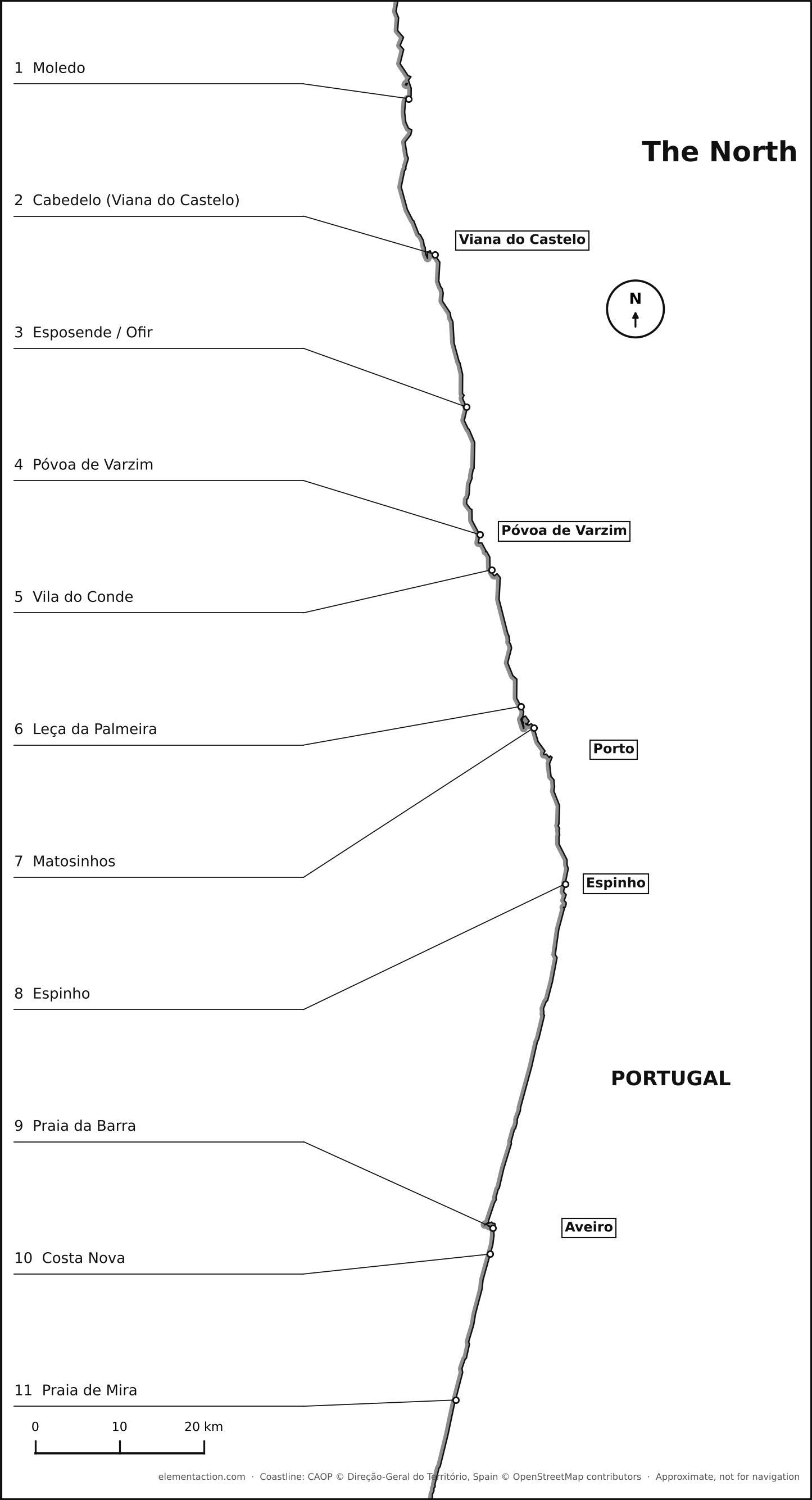
- Moledo: beach break at the mouth of the River Minho, the border with Spain. Popular with wind and kite surfers too.
- Cabedelo (Viana do Castelo): sand spit on the south side of the River Lima. Beach break peaks that handle a range of sizes. A busy windsurf and kitesurf spot as well.
- Esposende / Ofir: open, west-facing beaches either side of the River Cávado.
- Póvoa de Varzim: beaches plus reef and sandbar lefts. The reef is sharp, so mid to high tide is safer.
- Vila do Conde: more beach breaks just south of Póvoa.
- Leça da Palmeira: heavy beach break north of Porto's harbour. It also has a place in history: film from the 1920s, held in Portugal's national film archive, shows people riding waves on boards here (see our 1992 article).
- Matosinhos: sheltered by the Leixões harbour breakwater, it stays small when everything else is big. It is Porto's learner beach, with many surf schools.
- Espinho: jetties along the town beach shape rights and lefts. The backwash at high tide can spoil smaller days.
- Praia da Barra: beach at the entrance to Aveiro's harbour, beside the lighthouse.
- Costa Nova: the jetties at the Aveiro harbour entrance create sandbanks that can produce long, hollow rights and lefts. Big days mean a long paddle, so use the rips.
- Praia de Mira: consistent beach break among dunes, usually uncrowded.
II. The Centre: Figueira da Foz to Nazaré
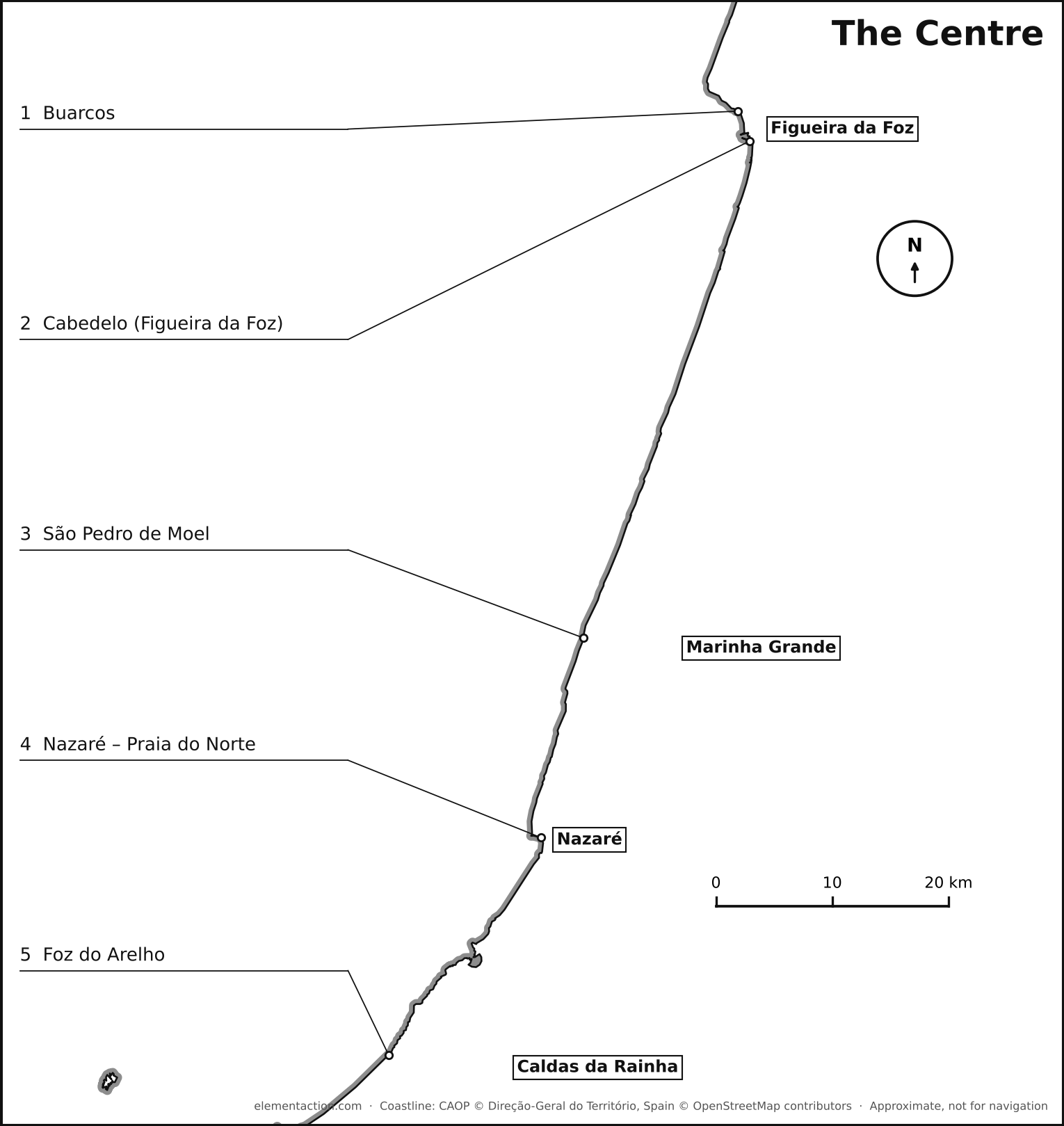
- Buarcos: at the north end of Figueira da Foz's bay, a long right breaks along the rocky shore when a big swell wraps in.
- Cabedelo (Figueira da Foz): classic rights on the south side of the Mondego river jetty, long known as one of the best waves on this coast. Surfers formed the SOS Cabedelo association in 2009 after a 50 m extension of the north jetty seemed to change the wave. In 2017 they were still fighting plans to extend it further.
- São Pedro de Moel: reefs and beach break at a small resort surrounded by pine forest, west of Marinha Grande.
- Nazaré, Praia do Norte: the big-wave beach north of the headland, where the Nazaré Canyon focuses swell into the biggest waves ever surfed. On normal days it is a heavy, powerful beach break, so treat it with respect. On big days, watch from the fort. Read the full story in Nazaré and Mavericks. The town beach south of the headland is sheltered and much smaller.
- Foz do Arelho: beach break where the Óbidos lagoon meets the sea.
III. Peniche and Baleal
Peniche is a fishing town on what was once an island, and it is now one of the main surf centres in Europe. What makes it special is that the peninsula has beaches facing almost every direction within a few kilometres. Baleal's bay faces roughly north-west, while Supertubos faces south-west, so one side is usually clean when the other is blown out. The Berlenga islands lie offshore.
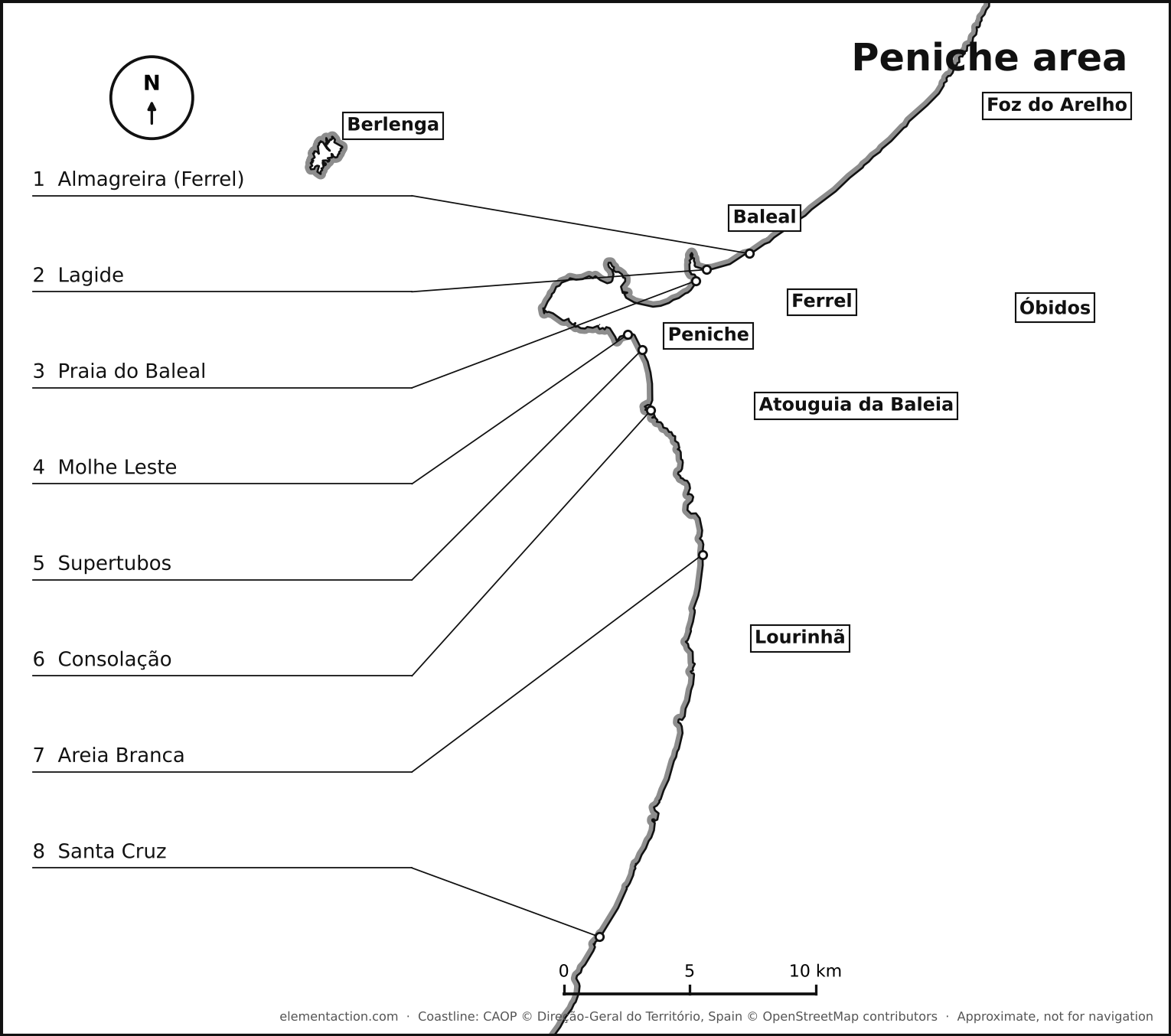
- Almagreira (Ferrel): open beaches east of Baleal that pick up the most swell on this side.
- Lagide: a left breaking over a rocky reef on the east side of Baleal. Shallow at low tide, and a magnet for camper vans.
- Praia do Baleal: the long, curved bay between Baleal and Peniche. It is protected, so it is a good place for learners and bodyboarders, and it holds the biggest swells.
- Molhe Leste: fast rights beside the eastern harbour jetty, just north of Supertubos. Needs a solid swell.
- Supertubos: Portugal's most famous beach break, described by Red Bull as "a beachbreak that thinks it's a reef". It is heavy, hollow and fast over shallow sandbanks. It has hosted the WSL Championship Tour almost every year since 2009, when Mick Fanning won the first Rip Curl Pro Search Portugal. It is crowded and shallow, so it is not for beginners.
- Consolação: reef and point just south of Supertubos, working in similar conditions.
- Areia Branca: beach break with a small river that forms good sandbars.
- Santa Cruz: exposed beaches and reefs further south, also popular with windsurfers.
IV. Ericeira: World Surfing Reserve
Ericeira, a former fishing village about 35 km north-west of Lisbon, has the highest concentration of quality reef and point breaks in Portugal. On 14 October 2011 it was dedicated as Europe's first World Surfing Reserve, and the second in the world after Malibu. The reserve covers about 4 km of coast and seven breaks: Pedra Branca, Reef, Ribeira d'Ilhas, Cave, Crazy Left, Coxos and São Lourenço.
Most of these spots are reefs over rock, so they suit experienced surfers. The beach breaks at the south end are better for learners.
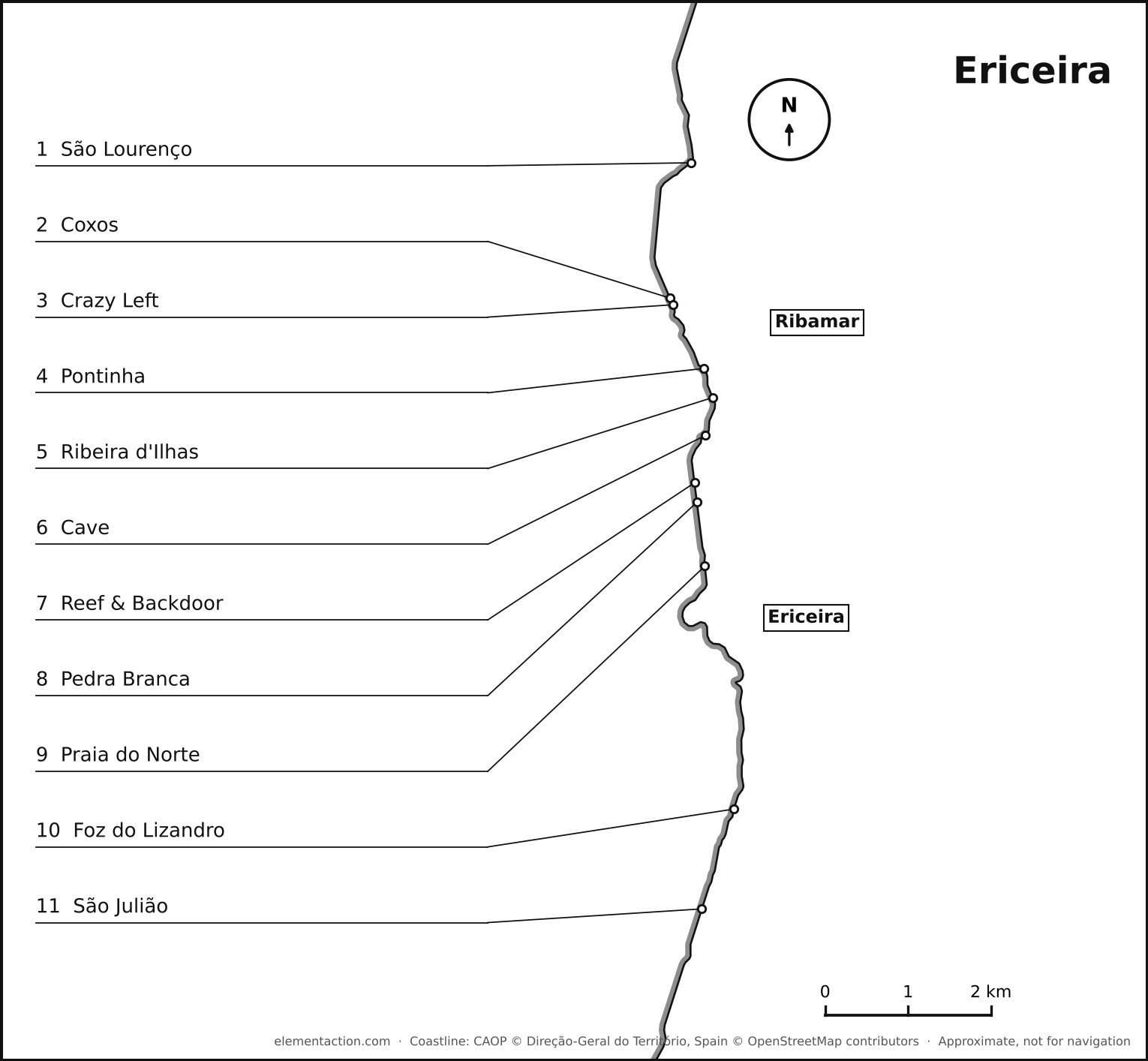
- São Lourenço: a right-hand reef far out from the beach. It handles big swells and has a steep, fast outside section. Best around low tide.
- Coxos: often called the best wave in Portugal. A powerful, hollow right over a shallow reef in a small bay. Best on N–NW swells with south-east offshore winds. It is crowded, with strong currents on big days, so experts only.
- Crazy Left: a shallow, hollow left on the south side of Coxos bay that wakes up on SW swells.
- Pontinha: a narrower right point north of Ribeira d'Ilhas, over a flat reef shelf.
- Ribeira d'Ilhas: a long right-hand point, about 3 km north of the town, where rides can reach about 275 m on a clean swell. It works on all tides and was the first spot in Portugal to host national and international contests. A statue called "The Guardian" above the beach marks the Reserve.
- Cave: a heavy right-hand slab that wakes up on winter swells. For experts only.
- Reef and Backdoor: a pair of reefs at Praia da Empa, north of the town. Backdoor is a right that barrels on swells over about 4 ft and is the friendliest of the breaks here.
- Pedra Branca: a shallow left over a rock platform in front of the campsite. Fast and powerful, and dangerous at low tide.
- Praia do Norte: the town's northern beach, with peaks and a left off the breakwater. Strong rips and a local crowd.
- Foz do Lizandro: a beach break with sandbars at the mouth of the Lizandro river. Suits learners and smaller days.
- São Julião: an open beach break further south, a good option when the swell is small.
V. Lisbon: Sintra, Cascais and Caparica
The Lisbon coast is where Portuguese surfing began. Pedro Martins de Lima, often called the father of Portuguese surfing, started riding waves on a board at Carcavelos in 1959. The area has two sides: the exposed west coast from Sintra to Guincho, and the south-facing "Estoril line" between Cascais and Lisbon, which needs a big W or S swell but is sheltered from north winds. South of the Tagus, the Caparica coast runs for more than 20 km.
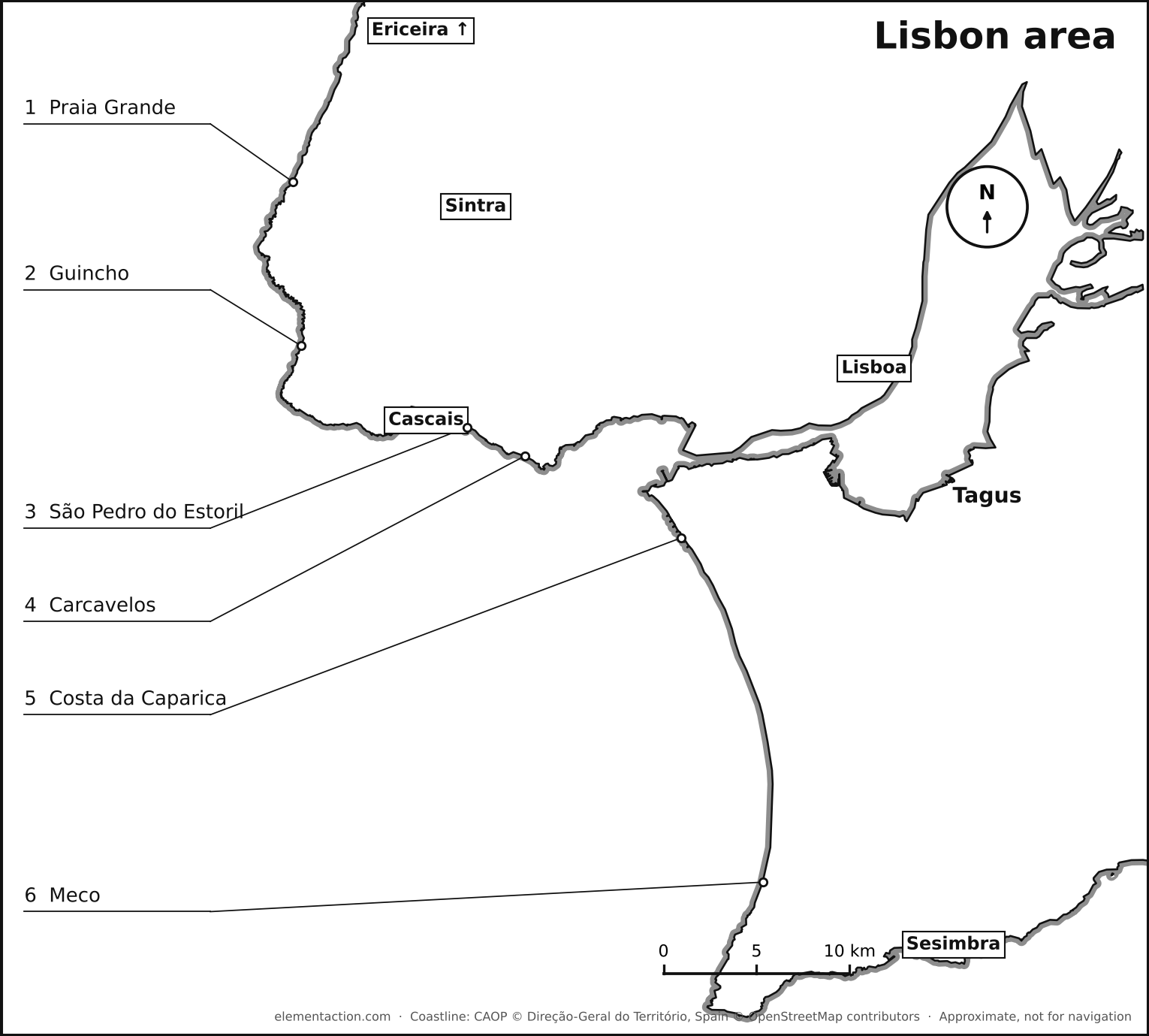
- Praia Grande (Sintra): one of the most consistent beaches near Lisbon, with a powerful shore break that is popular with bodyboarders. Praia Pequena, just north, is quieter.
- Guincho: an exposed, beautiful beach in the Sintra–Cascais natural park. It picks up a lot of swell, but it is often windy, which makes it a famous windsurf and kitesurf spot. Strong currents.
- São Pedro do Estoril: a right-hand reef point on the Estoril line. It works in big swells similar to those Carcavelos needs.
- Carcavelos: a long city beach and one of the first places Portuguese surfers rode, which is why it hosts so many contests. Powerful and tubular on its day, and crowded. Bathing has sometimes been banned after heavy rain, for example in 2017, when a stream overflowed onto the beach, so avoid surfing just after a storm.
- Costa da Caparica: a long, crescent-shaped coast with jetties at the north end and miles of beach break south of town. Easy access and plenty of room.
- Meco: more remote beaches towards Cabo Espichel.
VI. The South: Alentejo, Costa Vicentina and the Algarve
South of Lisbon the coast becomes wilder. The Alentejo and the Costa Vicentina, the Algarve's west coast, are a protected natural park with cliffs, river mouths and beaches at the end of dirt roads. At Cabo de São Vicente the coast turns east, and the Algarve's south coast picks up winter SW swells. Around Sagres you can choose between west-facing and south-facing beaches within ten minutes of each other.
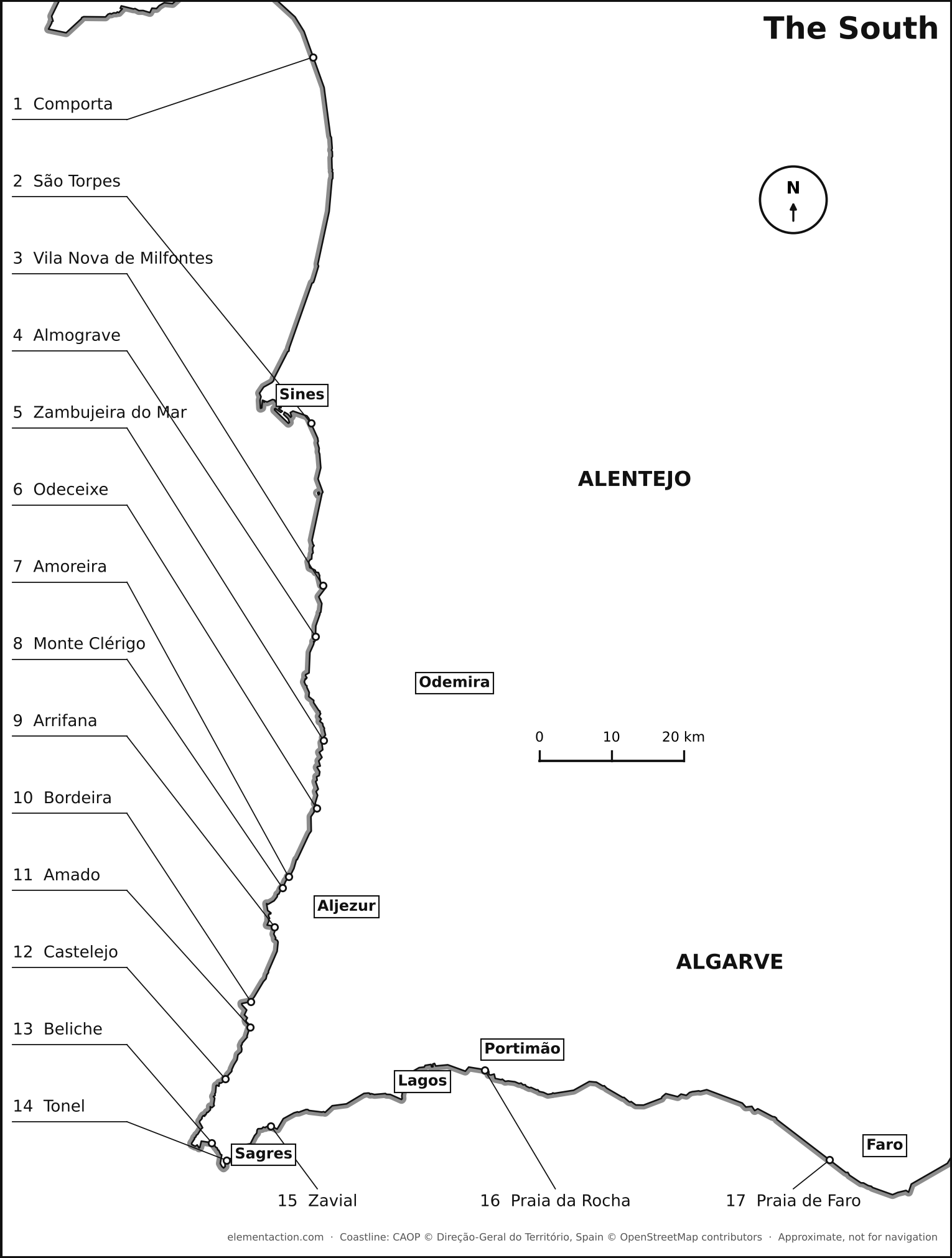
- Comporta: a long beach stretching south towards Sines, less exposed than the coast further south.
- São Torpes: a south-to-west-facing beach south of Sines, uncrowded and best in autumn and winter.
- Vila Nova de Milfontes: reefs and beaches around the mouth of the River Mira, including a long right.
- Almograve: cliffs and a beach break in the natural park.
- Zambujeira do Mar: a small clifftop village with a beach below.
- Odeceixe: a peaky beach break where the river marks the border between the Alentejo and the Algarve. Very consistent, with heavy close-outs when it is big.
- Amoreira: a beach at a river mouth with sandbanks, plus punchy peaks under the headland at low tide.
- Monte Clérigo: lefts and rights over sand at the north end; a hollow wave over rock in front of the village when it is big.
- Arrifana: a sheltered, south-west-facing bay. The sand suits beginners on small days, while a right-hand reef off the harbour is for experts.
- Bordeira (Carrapateira): a big, peaky beach break good for beginners in moderate swells, with rips near the cliffs and the river mouth. Carrapateira's fast left point works on bigger NW swells.
- Amado: a popular surf-school beach with peaks for all levels.
- Castelejo: an exposed west-facing beach below high cliffs, often among the biggest spots in the area.
- Beliche: a sheltered bay below the cliffs between Sagres and Cabo de São Vicente.
- Tonel: a compact beach near Sagres, fully exposed to W swells and hollow when it gets bigger.
- Zavial: a south-facing beach east of Sagres that comes alive on winter SW swells and north winds.
- Praia da Rocha: a town beach in Portimão that works when a south swell arrives, mostly in winter.
- Praia de Faro: the sand spit by Faro airport, surfable on south swells.
Before you go
- Respect the line-up. Reefs like Coxos, Supertubos and Pedra Branca have strong local crowds, and many have shallow, sharp bottoms. Learn on the beaches first.
- Check the water. Portugal's bathing-water season is monitored and the results are published each summer. In winter, avoid surfing near river mouths and city outfalls just after heavy rain.
- Wind beats swell. In summer, the north wind decides your day more than the swell does. Head for the south-facing beaches at Peniche, Cascais or Sagres in the afternoon.
- Bring booties for the reefs, where sea urchins are common.
- Read more: our guide to surf forecast sites and buoys and flying with a surfboard.
Sources
- The Stormrider Guide Europe (Low Pressure, 1992), Portugal chapter, used for spot structure and historical descriptions
- Surfer Today: Ericeira is a World Surfing Reserve
- Wikipedia: World Surfing Reserves (dedication dates)
- Surfer Today: Ribeira d'Ilhas, the ultimate European point break
- The Surf Atlas: Ericeira surf
- Surf-forecast.com: Coxos break guide
- Red Bull: Spot check, Supertubos, Peniche
- Diário de Notícias: Peniche hosts the world tour for the tenth year (2018)
- Diário de Notícias: SOS Cabedelo, the fight for a wave (2017)
- Surfer Today: Pedro Martins de Lima, the father of Portuguese surfing
- Surfer Today: Leça da Palmeira, the roots of European surfing
- Time Out Lisboa: Carcavelos closed to bathing (2017)
- The Surf Atlas: Aljezur surf
- Maps: coastline from CAOP, © Direção-Geral do Território; Spain from OpenStreetMap contributors (ODbL).
Read next
 November 3, 2026Portugal in 1992: What the Stormrider Guide SawIn 1992 the first Stormrider Guide Europe called Nazaré 'Portugal's most underrated wave' and Ericeira 'the Mecca of Portuguese surfing'. We read the Portugal chapter again, spot by spot, and checked what happened next.
 October 30, 2026Nazaré and Mavericks: Inside the World of Big-Wave SurfingA canyon that turns Atlantic swell into the biggest waves ever ridden, and a cold, shark-patrolled reef off California that one teenager surfed alone for years. The history, physics, records and risks of big-wave surfing at Nazaré and Mavericks.
 November 6, 2026Books for Surfers and Skaters: Culture, History and the RoadA Pulitzer-winning surf memoir, the novel that inspired Point Break, the bible of skateboard graphics and the stories of two teenagers who drove to Central America looking for waves. The books that best explain surf and skate culture, and the ones that make you want to travel.