2026年11月6日
Uncrowded Waves: Nine Surf Trips Away From the Crowds
Arctic beaches under the northern lights, a reef in the Scottish Highlands, a desert barrel in Namibia and a country that limits how many surfers may visit its waves. Nine destinations where you can still find space in the line-up, and how to travel there with respect.
Intro
The Endless Summer (1966) sent two surfers around the world looking for an empty, perfect wave, and they found it at Cape St. Francis in South Africa. Sixty years later, most famous waves are crowded. But there are still places where the line-up is quiet, usually because they are cold, far away, hard to reach, or protected by the people who live there.
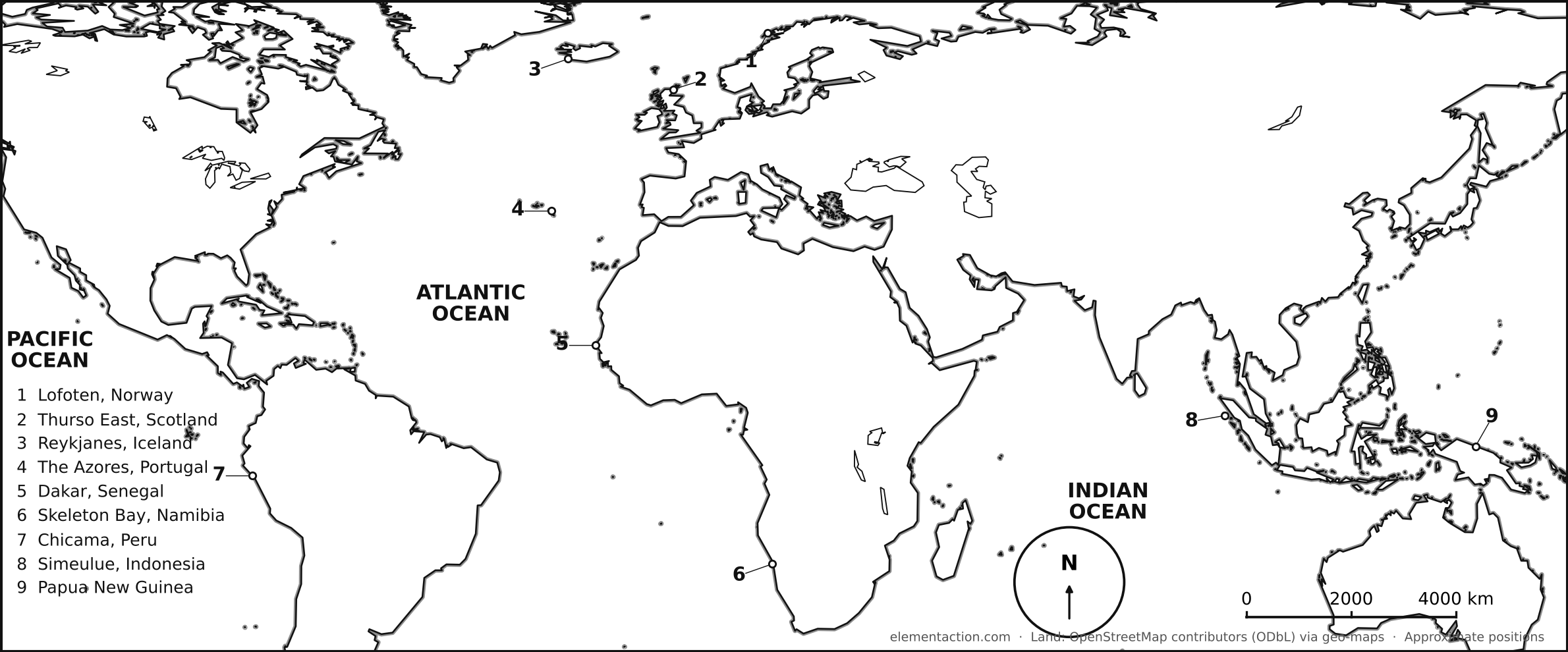
This article presents nine of them, from the Arctic to the tropics. They are all well-known surf regions that have been written about openly. We do not publish secret spots, and neither should you. Facts come from the sources listed at the bottom.
How to find empty waves
Before the destinations, the rules that make the biggest difference:
- Go cold. Cold water keeps crowds away. With a good 5/4 mm wetsuit, hood, boots and gloves, the North Atlantic opens up.
- Go far. The longer the trip from a big airport, the smaller the crowd.
- Go out of season. Many famous spots are almost empty outside the main season. You may get smaller waves, but you get them to yourself.
- Surf early and on weekdays. It sounds simple, but it works everywhere.
- Respect the locals. Uncrowded places stay uncrowded because they are treated with care. Pay local fees, follow local rules, and never post a spot that the locals keep quiet.
Europe and the North Atlantic
1. Lofoten, Norway
Unstad, a village at the end of a valley in the Lofoten Islands, faces the Norwegian Sea inside the Arctic Circle. According to Surfer Today, the Norwegian explorers Hans Egil Krane and Thor Frantzen were among the first to paddle out there in the mid-1960s. Today Unstad Arctic Surf offers rentals and coaching. The best season is November to March, when you can surf under the northern lights, but there are waves all year. Bring a thick hooded wetsuit, gloves and boots. Read more in our article on cold-water surf in Norway.
2. Thurso East, Scotland
On the north coast of mainland Scotland, at the mouth of the River Thurso, breaks one of the best reef waves in Europe: a long, fast right with barrel sections, holding swell from about 2 to 15 ft. From 2006 to 2011 it hosted an international contest, first called the O'Neill Highland Open and later the Coldwater Classic. The reef is shallow and sharp, so it is for experienced surfers.
3. Reykjanes, Iceland
The Reykjanes peninsula, about 50 km from Reykjavík, is Iceland's main surf region. Its lava reefs are often empty even on good days. Surfer Today lists spots for all levels, from beach breaks for beginners to right-hand reefs for experts. The best time is autumn and winter, with September to November giving a good balance between waves and weather. Summer often goes flat. The south and west coasts get some warmth from the North Atlantic Drift, but the water is still very cold.
4. The Azores, Portugal
Nine volcanic islands in the middle of the Atlantic, open to swell from almost every direction. São Miguel is the main surf island, with beaches and reefs around Ribeira Grande, while islands such as São Jorge have long lefts at the foot of the cliffs. Read about the islands' surf history and spots in Portugal in 1992: What the Stormrider Guide Saw.
Africa
5. Dakar, Senegal
The Endless Summer opened its world trip on N'Gor Island, a short boat ride from Dakar, where Mike Hynson and Robert August rode the N'Gor Right. Dakar sits on the westernmost point of mainland Africa, and the Almadies peninsula is exposed to swell from a very wide window, so it rarely goes flat. According to Carve Magazine, the area has about 15 quality spots. Senegal now has a growing local scene, including pro surfers, and visitors are expected to share the waves with them respectfully.
6. Skeleton Bay, Namibia
A left-hand point break where the desert meets the sea, near Walvis Bay. It became known in 2008, after a reader of Surfing magazine spotted it on Google Earth and Cory Lopez surfed it on film a few months later. According to Surfer Today, rides can last up to 2 km and include several barrels. The best months are June to September, the water is 14–20°C, and you must walk back up the sand after each wave. Be honest with yourself: this wave is remote but not empty on the best swells, when the world's best tube riders fly in. On ordinary days you may share it with only a few people.
South America
7. Chicama, Peru
A left point on Peru's north coast, famous for rides that last minutes rather than seconds. Peru is also a pioneer in protecting waves: its Ley de Rompientes (surf break law) took effect in 2014, and Chicama was the first wave registered under it, in 2016, according to Snopes' fact check. Dozens of other Peruvian spots have been added since.
Asia and the Pacific
8. Simeulue, Indonesia
The northernmost of the big islands off Sumatra's west coast, north of Nias, in Aceh province. According to Perfect Wave Travel, it has more than a dozen quality breaks, from barrelling reefs to easier beach breaks, and is much less crowded than other parts of Indonesia. The most consistent swells come from April to October, and the water is about 28°C. Access is by domestic flight from Medan.
9. Papua New Guinea
The best example of how a country can keep waves uncrowded on purpose. The Surfing Association of Papua New Guinea runs a surf management plan: the number of surfers in the water is limited, and visitors pay fees to the coastal communities that own the reefs under customary law. According to Surfer Today, the idea goes back to 1989 and is credited to Andy Abel, and the plan is used in areas such as Vanimo, Tupira, Kavieng and New Ireland. Visits are arranged through community-run surf clubs. According to The Inertia, visiting surfers pay about $12 a day, and at the end of the season each club and its community decide how to spend the money, for example on schools or clean water. The result is a line-up that stays small and local people who benefit from surfing.
Quick comparison
| # | Destination | Water | Best time | For |
|---|---|---|---|---|
| 1 | Lofoten, Norway | Very cold | Nov–Mar | All levels at the beach |
| 2 | Thurso East, Scotland | Very cold | Autumn–winter | Experienced |
| 3 | Reykjanes, Iceland | Very cold | Sep–Nov | All levels |
| 4 | The Azores | Cool | Autumn–spring | All levels |
| 5 | Dakar, Senegal | Cool to warm | Varies by spot | All levels |
| 6 | Skeleton Bay, Namibia | 14–20°C | Jun–Sep | Experts |
| 7 | Chicama, Peru | Cool | Varies with swell | Intermediate+ |
| 8 | Simeulue, Indonesia | ~28°C | Apr–Oct | All levels |
| 9 | Papua New Guinea | Warm | Varies by region | All levels, via local surf clubs |
"Best time" and "for" are summaries of the sources below. Always check a forecast and ask locally before you go.
Respect the waves
A few habits help keep these places as they are:
- Pay the fees where they exist, such as Papua New Guinea's levies.
- Share the photos, not the coordinates, of places the locals keep quiet.
- Learn the local etiquette before you paddle out, and remember that you are the guest.
- Leave nothing behind. Remote beaches have no one to clean up after you.
More inspiration: books for surfers and skaters and legendary surf and skate films, including The Endless Summer.
Sources
- Wikipedia: The Endless Summer
- Surfer Today: Surfing Lofoten, riding the waves of the Arctic Circle
- Wikipedia: Thurso East
- Surfer Today: Thurso East, the dreamy and cold Scottish Highland wave
- Surfer Today: The best surf spots in Iceland
- Carve Magazine: The sound of Senegal (2019)
- Surfer Today: Skeleton Bay, the endless Namibian barreling wave
- Snopes: Is Chicama the world's only legally protected wave?
- Perfect Wave Travel: Simeulue surf guide
- Surfer Today: Surf management plan hailed a success in Papua New Guinea
- The Inertia: Is Papua New Guinea's surf management plan the way of the future?
- Map: land from OpenStreetMap contributors (ODbL) via geo-maps. Positions are approximate.
あわせて読みたい
 2026年11月6日英語のみBooks for Surfers and Skaters: Culture, History and the RoadA Pulitzer-winning surf memoir, the novel that inspired Point Break, the bible of skateboard graphics and the stories of two teenagers who drove to Central America looking for waves. The books that best explain surf and skate culture, and the ones that make you want to travel.
 2026年11月6日英語のみLegendary Surf and Skate Films: From The Endless Summer to Mid90sA $50,000 travel film that made over $20 million, a skate video that launched an actor's career, and an Oscar-nominated documentary about three friends in Rockford, Illinois. The surf and skate films every board rider should see, and why they matter.
 2026年10月31日デザイン英語のみThrough the Lens: The Photographers Who Framed Board CultureSurfing, skateboarding and snowboarding became cultures as much through photographs as through riding. Meet the photographers who invented how board sports look, from LeRoy Grannis on the beach in the 1960s to Glen E. Friedman in the drained pools of Dogtown.